
The Missing Skill: Teaching Students How to Think About Thinking
The Metacognitive Cycle in Action
To stay updated with the latest education news, I often listen to podcasts. In June, I tuned in to one of my favorites, the Teach Middle East Podcast, hosted by Leisa Grace Wilson, an expert on the UAE's education scene. An episode titled "How To Build Metacognition Into Everyday Teaching" with Nathan Burns particularly stood out. Although metacognition isn't a new concept, Mr. Burns's point that it involves challenging knowledge and fitting it into our schemas and mental models made me reflect again. It prompted me to consider the various ways we can help children engage in metacognition effectively.
Two Students: Two Different Approaches
Two students complete the same task simultaneously. Student A finishes and informs the teacher she is "done." Meanwhile, Student B is still working, often pausing to reread the questions and questioning whether his answers are complete and accurate. They pause to reflect, make some corrections, and continue. The key difference isn’t intelligence or laziness; it’s that Student B is engaging in metacognition, actively thinking about his own thinking.
Plainly, that’s what metacognition is: the ability to plan, monitor, and evaluate your own learning. It involves knowing what you are doing, understanding whether it is working, and adjusting if it isn’t. John Flavell, a developmental psychologist, coined the term metacognition and described it as our knowledge of and regulation of our own cognitive processes (Flavell, 1979). Metacognition sits under the broader umbrella of self-regulated learning, which encompasses the behaviors and motivation that accompany thinking (Zimmerman, 2002). Simply stated, metacognition empowers students to take the helm of their own learning rather than play a passive role.
Over the past year, I've noticed a rise in articles and podcasts discussing metacognition. I asked Claude to find out how many such materials were published in 2026, and within just two minutes, it identified six articles and one podcast from the United States. In the UAE, it located the Teach Middle East episode and an article from The British International School Abu Dhabi. However, if I were to ask educators how they apply metacognitive knowledge or regulation, many would find it difficult to give specific examples. This gap between recognizing the term and understanding its practical application is the missing skill.
Why It Needs To Be On Your Radar
Metacognition is not just another initiative, as evidenced by the surge in recent research and the publication of scholarly articles. The Education Endowment Foundation, which compiles the preeminent research for schools, rates metacognition and self-regulation as “high impact for very low cost,” offering approximately eight additional months of progress over the course of a year, based on its evidence (Education Endowment Foundation [EEF], 2025). There are very few strategies that yield such a lasting impact on student progress and attainment for no expense outside of professional development. Extensive research supports this. According to Dignath and Büttner (2008), a meta-analysis of 84 intervention studies in classrooms at both the primary and secondary levels showed an average effect size of 0.69, a significant improvement, benefiting both age groups.
Likewise, a review concentrating only on schools identified consistent, moderate impacts on achievement and beneficial effects on students’ well-being (Perry et al., 2019). Its cost-effectiveness and success originate from the same root: metacognition is not a separate program or subject to be scheduled; instead, it embodies a change in teaching methodology.
Metacognition in Action: Plan, Monitor, & Evaluate
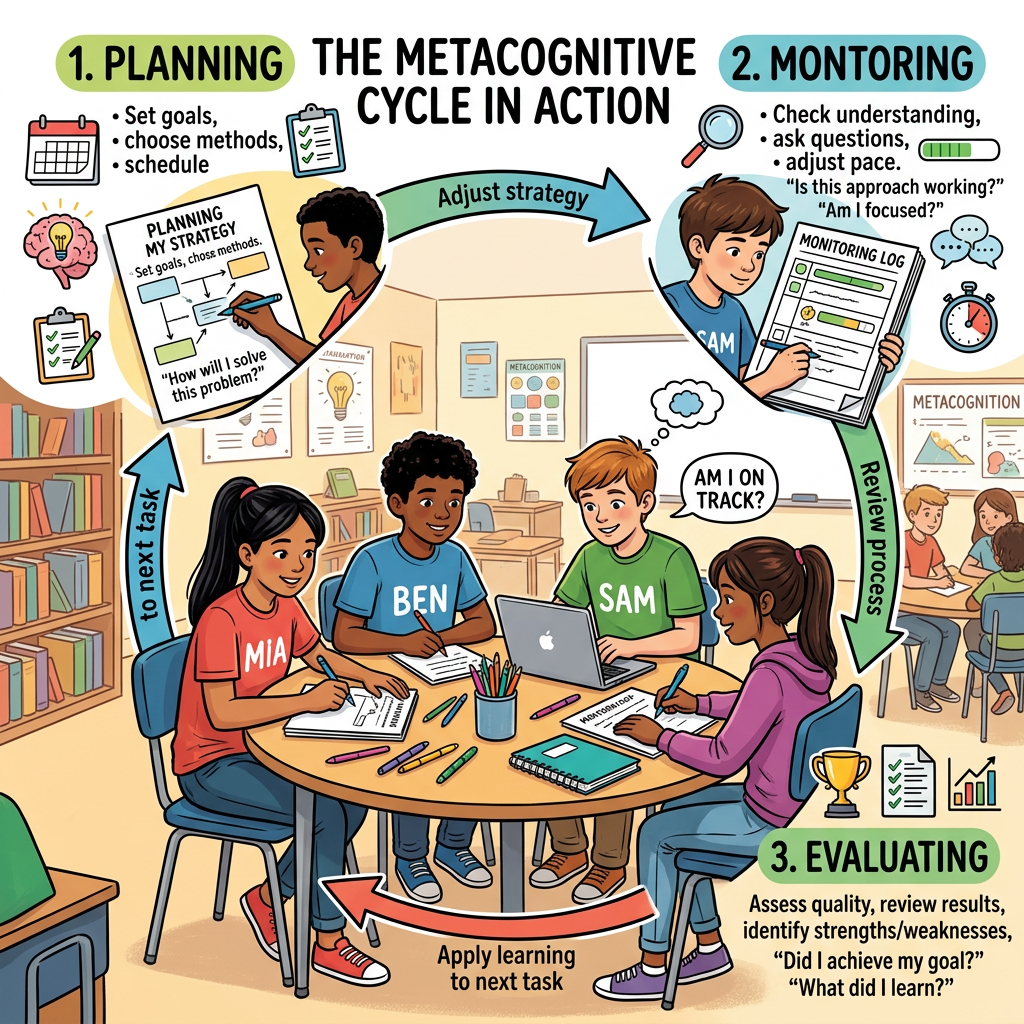
The clearest way to visualize metacognition is as a three-part cycle (Zimmerman, 2002; Quigley et al., 2018).
Plan (before) – The learner asks: What tasks am I being asked to complete, and what’s my strategy? A child about to solve a math word problem might use a strategy like CUBES to simplify their problem-solving.
Monitor (during) – While the student is working on his task, he might pause and ask, "Is this working?" For instance, a learner writing an essay may reread her work, notice she's repeated similar phrases, and make the necessary corrections.
Evaluate (after) – After completing an assignment, the learner reflects on the process, considering how it went and what they would change if they could do it again. The modifications students choose for future similar tasks mark the final stage in this cycle. Today’s evaluation informs tomorrow’s planning. Over time, if consistently practiced, this cycle enhances itself and produces compounded growth.
Video: Metacognition — A Brief Explainer (Education Endowment Foundation, 2023)
Five Classroom Metacognition Routines
At the time of writing this article, we are starting the second week of the academic year in Dubai. When I was a full-time teacher, I always identified new strategies to implement in my classroom over the summer and planned for them. Below are five easy routines that require no new resources or separate scheduling. Instead, these are five practices that you can plan to implement at any time of the year. All that is required is planning and consistent instructional delivery.
1. Think Aloud – Vocalize your reasoning so students can hear how you think: “This science experiment requires a constant. I need to identify all parts that remain unchanged despite varying variables.” One of the best strategies teachers can use is to make expert thought processes audible (Rosenshine, 2012). Modeling thinking aloud gives students a framework for developing their knowledge and thinking.
2. Explicitly teach and prompt strategies. – Don't assume students know what to do. Name each strategy, demonstrate it, and provide prompts as students engage in the Metacognitive Regulation Cycle (Education Endowment Foundation [EEF], 2025). This scaffolding supports students until they internalize the process (Quigley et al., 2018).
At my previous school, middle school students consistently followed this routine across all subjects, especially in math. The Head of Mathematics would give students at least two problem-solving strategies, which he modeled explicitly on the board. When students were ready to work, either alone or in groups, he circulated with the strategies displayed; if he saw a student struggling, he would refer to them and prompt them to use one. After completing their work, he would, if time allowed, ask students to reflect on whether there was an alternative way to solve the problem. This approach encouraged students to extend their thinking.
3. Pair retrieval with reflection. – After a quiz or assessment, invite students to reflect by asking, "Which of these questions did you know well, and what will you review before our next lesson?” This approach reinforces memory through recall and helps learners identify what they need to review next (Dunlosky et al., 2013). It also encourages students to take greater ownership of their learning.
In 2012, I attended a professional development session on debriefing with students after assessments. The session focused on helping students see tests as tools for demonstrating their understanding and, afterward, reflecting on what they understood and what they still needed to learn. I kept this practice in mind when designing long-term plans and pacing guides. Whenever I recommended a pace for a one- or two-week period, I set aside one day for this reflection exercise.
4. Ask “why” instead of just “what”. – Encourage students to explain their reasoning in addition to answering. Prompting this kind of self-explanation deepens understanding (Chi et al., 1994). Students can then retain what they learn longer because they apply their knowledge, depending on the task, and evaluate whether their line of thinking is the correct approach.
One strategy I have used successfully in the classroom and shared with other teachers over the years is Claims, Evidence, Reasoning (CER), especially in STEM subjects. In my experience, children often struggle with explanatory (non-fiction) text because of academic vocabulary or the complexity of the concept. I have found it useful to scaffold their understanding by not simply asking them to state their claim (the what), but also to identify the evidence they used to reach that answer and explain (the why).
5. Make reflection structured and routine. Exit tickets, learning journals, and end-of-task review prompts are different tasks students can use to hone their evaluation skills. When providing feedback on journals, include time in the class period for students to respond to your feedback, and include a prompt to reflect on what they would change to improve their performance on a specific task and what they did well.
As you may have already realized, none of these strategies requires purchasing new resources or adding time to the schedule. They only require a change of habit.
Getting it right by phase
One reason metacognition can disappoint is that it’s taught the same way to elementary and high school students. Evidence shows that self-regulation strategies work at both the primary and secondary levels, but the strategies that work vary with age (Dignath & Büttner, 2008; Quigley et al., 2018).
In the early years, keep metacognition concrete and verbal: name a feeling about a task (“this is tricky, so I’ll go slowly”), say “what’s my plan?” aloud, and model these approaches often. In upper primary, students can begin choosing between strategies and reflecting in writing, with prompts still close at hand. By secondary school, the focus shifts to subject-specific strategies, applying approaches across topics, and evaluating their own study choices. The progression is straightforward: start young, build sophistication, and keep teaching metacognition explicitly. Students don’t simply grow into it on their own.
From the region
UAE schools are speaking about metacognition too. In the episode “How to Build Metacognition into Everyday Teaching,” the Teach Middle East Podcast argues that metacognition raises attainment when it’s taught deliberately and woven into school life, not bolted on (Teach Middle East Podcast, 2026). It’s already evident in UAE classrooms: The British International School Abu Dhabi reports that daily thinking routines are building students’ confidence, independence, and engagement, the very human skills that matter most in the age of AI (British International School Abu Dhabi, 2026).
Four common implementation errors (and how to avoid them)
Even committed teachers can weaken the impact of metacognition. The usual culprits (Quigley et al., 2018; Rosenshine, 2012):
· Turning the metacognitive process into another worksheet. Reflection cannot be confined to a box to check. Prompts should be brief. When possible, use them verbally, and they should always connect to the current work.
· Strategy and content should appear in tandem. Metacognition works within subject knowledge, not as a standalone “thinking skills” lesson. Embed it into lessons across subjects.
· Assuming transfer, students rarely apply a strategy independently in a new context. Model it again whenever the context changes.
· Overloading working memory. Adding metacognitive prompts to a task that is already multi-layered and complex can backfire. Introduce them when the student is comfortable with the content.
Consider starting on Monday with two strategies: Thinking aloud is one of the simpler strategies to implement, regardless of the content. Initially, it puts the work on the teacher, and students will naturally begin to internalize the process. The second change I recommend starting with is asking why. You can start this as part of your questioning routine, as you elicit verbal responses that dig deeper into their thinking. Once that is established as the norm, you can begin to embed it in written work. Remember, building consistent habits is more successful than making large changes that don’t stick.
There’s a bigger prize here, too. Students who can plan, monitor, and evaluate their own learning will keep learning long after they leave our classrooms, truly becoming lifelong learners. They develop adaptability and are ready for whatever the future brings.
